
Canada's Private Surgery Access Network · Serving All 10 Provinces & 3 Territories

Private Ankle Replacement Surgery in Canada

An arthritic ankle is bone grinding on bone with every step you take, and there is no way to walk without taking steps. When it reaches the end, you face a genuine, life-shaping decision that a lot of patients are never properly offered: replace the joint, or fuse it. They are very different futures, and the choice is yours to understand.

A patient walking comfortably after private ankle replacement surgery
2 paths Replace the joint, or fuse it. Understand both.

Procedure Time

1 to 2 hours

A major reconstruction of the ankle joint, under general or regional anesthetic.

Hospital Stay

1 to 2 nights

Unlike the smaller foot operations, this needs a short inpatient stay before you travel home.

Off The Foot

6 to 12 weeks

A period in a cast or boot, non-weight-bearing at first, while everything heals. This is not a quick recovery.

The Payoff

A walkable ankle

Pain relief, and with a replacement, a joint that still moves. For the right patient, that is transformative.

What is ankle replacement?

When the cartilage in your ankle wears out, the two bones that meet there grind directly against each other. Every step drives that grinding, which is why ankle arthritis is such a relentless, step-by-step kind of pain. Often it follows an old injury, a bad fracture or years of instability, decades after the event.

In a total ankle replacement, the worn ends of the two bones are removed and replaced with metal and plastic components that form a new, smooth-moving joint. The crucial thing about it, and the reason it exists, is that it keeps the ankle moving. You still bend the joint to walk, to go up stairs, to manage a slope, rather than losing that motion entirely.

The alternative is to fuse the ankle, joining the bones permanently into one so they can no longer grind. Fusion also relieves the pain, and it is tremendously durable, but it removes the movement of the ankle for good. Which of these is right for you is the most important conversation on this page, and it is one many patients are simply never given.

All Foot & Ankle Procedures
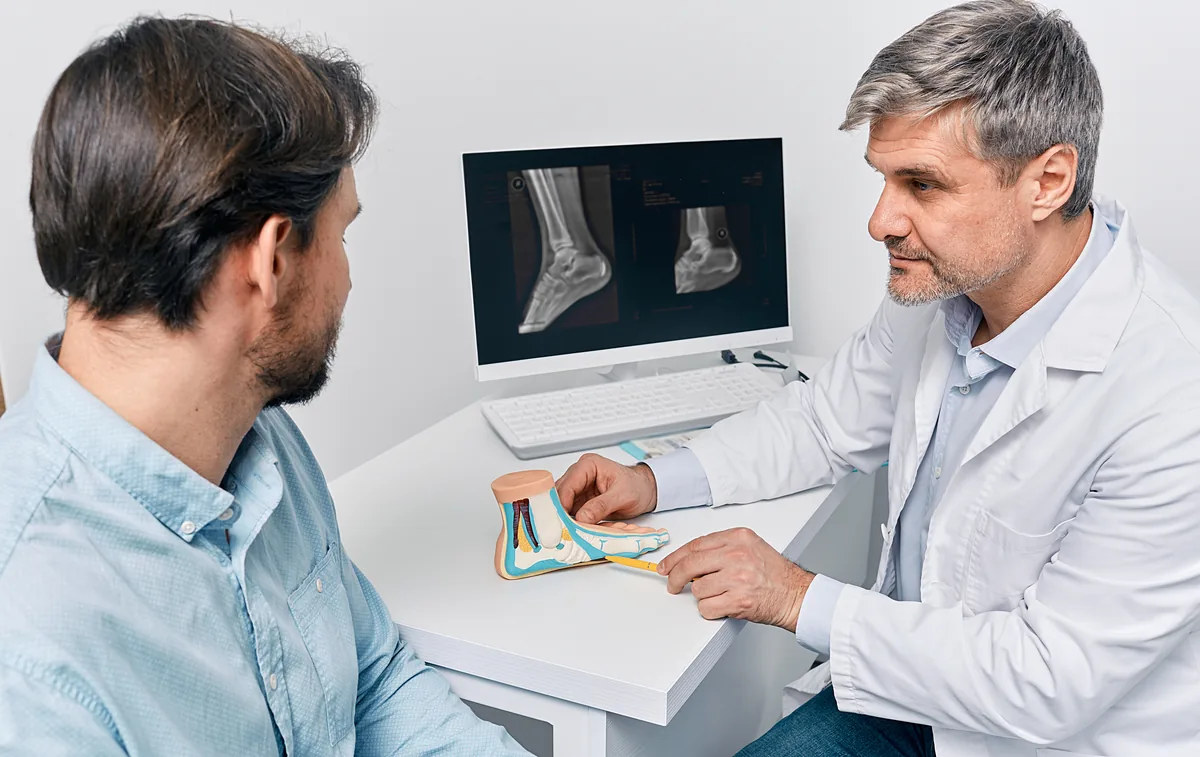
A foot and ankle surgeon reviewing an ankle X-ray with a patient

Replace it, or fuse it? The decision you deserve to make.

For decades, fusion was simply what you got for an arthritic ankle. Replacement has changed that, and for many people it is now a genuine alternative. Neither is automatically better. They are different trades, and the right one depends on you.

Keeps Motion

Total Ankle Replacement

The joint is rebuilt with implants, and it keeps moving. You walk more naturally, and the neighbouring joints in the foot are spared the extra strain that fusion transfers to them. It is the option many patients never realise they have.

Best for
Preserving a natural walking pattern, and protecting nearby joints
Motion
Kept
Durability
Good and improving, but the implant has a finite lifespan
Suits
Often lower-demand or older patients, though selection is individual
Trade-off
May eventually need revision, like any joint replacement
Most Durable

Ankle Fusion

The bones are permanently joined so they cannot grind. It is extremely durable and relieves pain reliably, which is why it has been the standard for so long. The cost is the ankle's own movement, given up for good.

Best for
Heavy demand, younger active patients, severe deformity
Motion
Lost at the ankle, permanently
Durability
Excellent; nothing to wear out or revise
Suits
Those who will load the ankle hard for years to come
Trade-off
Extra strain passes to nearby joints, which can wear over time

What the evidence actually says. Recent high-quality studies, including a large randomised trial, have found that replacement and fusion give broadly similar pain relief and function, each with its own advantages: replacement tends to look better in the short term on patient-reported outcomes, fusion tends to show fewer late complications and revisions over the long haul. In other words, the trials confirm this is a real choice rather than one right answer. The decision turns on you: your age, your weight, how hard you will use the ankle, the shape of the joint, and how much the motion matters to you. Because our surgeon performs replacement, both options are genuinely on the table, and you get the conversation instead of the default.

Are you a candidate for ankle replacement?

Not every arthritic ankle is ready for surgery, and not every ankle that needs surgery should be replaced rather than fused. Both of those judgements are what a proper assessment is for.

Surgery may be right if you have

  • End-stage ankle arthritis, with bone grinding on bone on your X-rays
  • Pain with every step that limits how far you can walk and what you can do
  • Arthritis that followed an old fracture or years of instability
  • Pain that persists despite bracing, injections, footwear and physiotherapy
  • A willingness to commit to a recovery measured in months, not weeks

What your surgeon will assess

  • Whether replacement or fusion suits your ankle better, which is the key question
  • Your age, your weight and how hard you will load the ankle in the years ahead
  • The alignment and shape of the ankle, and any deformity that must be corrected
  • The health of the nearby joints, which changes the calculation
  • Your general health and readiness for a major reconstruction and anesthetic

If your arthritis is not yet end-stage, or simpler measures have not been exhausted, we will tell you it is not time yet. And if fusion genuinely suits your ankle better than a replacement, we will tell you that too, even though it is the option we do not brand around. Ask a coordinator.

Your recovery, step by step.

This is a major operation and a long recovery, and we would rather you knew that going in. The reward is at the end, and it is worth the patience the middle demands.

In Hospital

A short inpatient stay while the pain is controlled and the ankle is protected in a cast or splint. You are up on crutches, not on the foot.

Off The Foot

A period in a cast or boot, keeping weight off the ankle while it heals. Elevation and patience are the whole job. Desk work can sometimes resume.

Weight Returns

As the X-rays allow, you gradually put weight through the ankle, moving out of the boot. Physiotherapy begins in earnest.

Rebuilding

Walking distance and strength grow steadily. You return to normal daily life, and the value of a pain-free step becomes real.

The Full Result

Strength, endurance and confidence keep building for up to a year. With a replacement, you keep the ankle's movement as well as losing the pain.

Timelines are typical ranges, not promises, and both operations demand a genuine commitment of months. Two honest points specific to the choice you made. An ankle replacement is a joint replacement, and like any joint replacement the implant can wear or loosen over many years and may eventually need revision, which is a real consideration if you are younger. A fusion does not wear out, but by removing the ankle's motion it loads the neighbouring joints of the foot more heavily, and those can develop arthritis of their own over time. Neither is a free lunch, and your surgeon chose with you which trade fits your life. ACCESS coordinates your cast changes, X-rays and physiotherapy close to home throughout.

What does private ankle replacement cost in Canada?

There is no single price for an ankle replacement, and any website that hands you one is quoting a case it has never seen. This is the largest foot and ankle procedure, and the cost reflects that.

Rather than post a number that may have nothing to do with your situation, we do something more useful: we review your imaging and history, help you decide between replacement and fusion, and give you one written, all-inclusive quote before anything is booked.

  • Replacement or fusion. The two operations differ in implants and complexity, and so in cost.
  • The implant. A total ankle replacement uses a specific implant system, which is a significant part of the cost.
  • Any deformity to correct. If the ankle is not just worn but crooked, straightening it adds to the operation.
  • Your inpatient stay. This operation needs a short hospital stay, which is priced in rather than assumed away.
  • Your rehabilitation plan. An ankle recovery runs for months, and the physiotherapy is part of the result.

Worth asking your coordinator about: third-party financing is available through established partners, and some private medical expenses may qualify for the Canada Revenue Agency's Medical Expense Tax Credit. We will walk you through all of it.

Get Your Personal Quote

Your ACCESS Quote

What a single, all-inclusive quote covers

  • Your surgeon's fee
  • Physician anesthesia
  • The accredited facility, the operating room and your inpatient stay
  • Your implant or fusion hardware, and your cast or boot
  • ACCESS coordination, from first call to follow-up

Set out separately, never buried: travel and accommodation, which matter more here given the stay, and anything outside the surgical package such as the months of physiotherapy. You see every line before you commit. No hidden fees, ever.

Ankle replacement questions.

Straight answers to what patients ask us most about private ankle replacement in Canada.

This is the real question, and there is no single right answer, which is exactly why you deserve the full conversation. Both operations reliably relieve the pain of an arthritic ankle. Replacement keeps the joint moving, so you walk more naturally and the neighbouring joints are spared extra strain, but the implant has a finite lifespan and may eventually need revision. Fusion is extremely durable and nothing wears out, but it removes the ankle's motion permanently and transfers load to the nearby joints, which can wear over the years. Recent high-quality studies, including a large randomised trial, found the two give broadly similar pain relief and function, confirming this is a genuine choice. It turns on your age, weight, activity, the shape of your ankle and how much the motion matters to you. Because our surgeon does both, you get an honest recommendation rather than the default.

There is no single price. This is the largest foot and ankle procedure, and your cost depends on whether you have a replacement or a fusion, the implant used, whether a deformity also needs correcting, the length of your inpatient stay, and your rehabilitation plan. Instead of quoting a range that may not apply to you, ACCESS reviews your imaging and history, helps you decide between replacement and fusion, and gives you one written, all-inclusive quote covering the surgeon, anesthesia, the facility and stay, the implant or hardware and our coordination. Financing options and the CRA Medical Expense Tax Credit may also apply.

Long. Ankle replacement sits within orthopedics, which the Fraser Institute's 2025 survey of Canadian physicians put at a median 48.6 weeks from family doctor referral to treatment, the second longest of any specialty, and it is not among the benchmarked procedures Canada reports against, unlike hip and knee replacement. So an ankle, joint for joint just as disabling as a hip or a knee, waits without even the accountability those procedures have. Every month of that wait is another month of pain with every step, on a joint you cannot rest because you have to walk on it.

Modern ankle replacements are far more durable than the early designs that gave the operation a poor name decades ago, and outcomes have improved substantially. Like any joint replacement, though, the implant does not last forever: it can wear or loosen over many years and may eventually need revision surgery. This is one of the central reasons the replacement-versus-fusion decision is so individual. A younger, heavier or more active person, who will load the ankle hard for decades, may be better served by a fusion that never wears out, whereas a fusion also has its own long-term cost in the strain it puts on the neighbouring joints. Your surgeon will give you a realistic picture of longevity for your specific situation rather than a headline number.

This is a major operation with a recovery measured in months, and we would rather be blunt than optimistic. Expect a short hospital stay, then a period of six to twelve weeks in a cast or boot, keeping weight off the ankle at first and gradually loading it as the X-rays allow. Physiotherapy runs alongside, and strength and walking distance keep building for up to a year. Desk work can sometimes resume within a few weeks if you can keep the foot elevated, but anything on your feet waits considerably longer. This is not an operation to have if you cannot give it the recovery it needs, and your surgeon and coordinator will make sure you have planned for it before you commit.

Yes, with the travel planned carefully around a bigger recovery. Travelling within Canada for privately funded surgery is a legitimate, well-established pathway, and coordinating it is exactly what ACCESS does. Because this operation needs a short inpatient stay and then keeps you off the foot, we plan your stay before you fly home, fit you with your cast or boot, and arrange the crutches, the aisle seat and the cars. Your cast changes, X-rays and the months of physiotherapy are then all coordinated near where you live, so the distance never becomes the obstacle to the recovery.

Related procedures.

Explore the other foot and ankle procedures we coordinate across Canada.

Forefoot

Bunion Surgery

Correcting the deformity, not just the bump. Modern minimally invasive correction, with a low recurrence rate.

Learn More
Tendon

Achilles Tendon Repair

For a ruptured Achilles. The one procedure where waiting changes the operation into a bigger one.

Learn More
Specialty

All Foot & Ankle Surgery

Explore the full range of foot and ankle procedures we coordinate, and how the trip and recovery work.

View Specialty

Walk without counting the steps.

Speak with a care coordinator about your ankle, and understand the real choice between replacing it and fusing it. No referral needed, no obligation, and a clear quote before anything is booked.