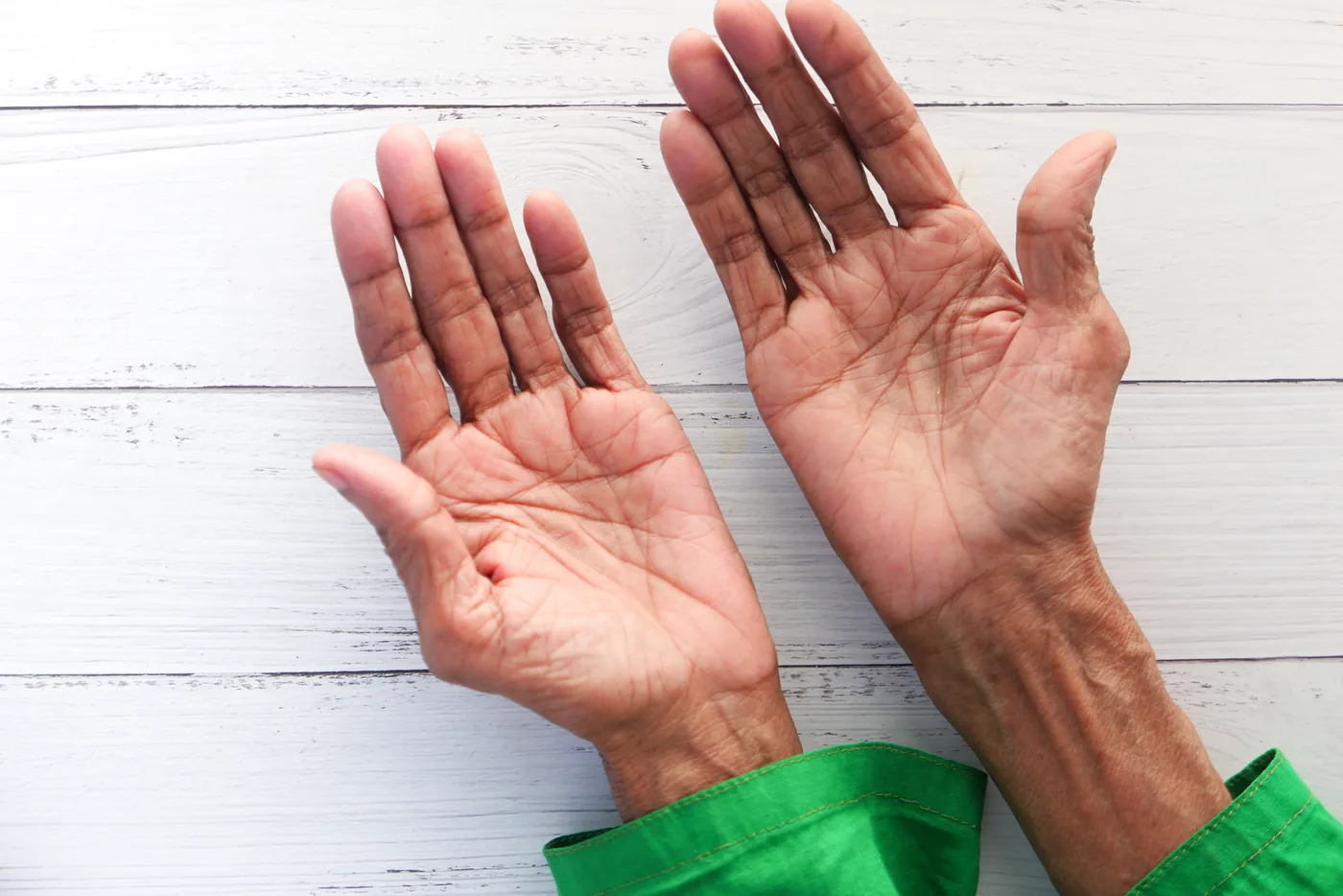
Private Dupuytren's Contracture Treatment in Canada
It begins as a small lump in the palm, painless and easy to ignore. Over years, a cord forms under the skin and slowly pulls a finger down toward the palm, until you cannot lay your hand flat, cannot get it into a pocket, cannot shake hands properly. There is a real decision to make about how to treat it, and almost nobody explains it.
2 optionsA needle, or a knife. The choice is yours.
The Test
The tabletop test
If you cannot lay your palm flat on a table, that is the classic sign it is time to consider treatment.
Two Real Options
Needle or surgery
A quick needle procedure, or a more thorough operation. They trade recovery against how long the result lasts.
Recovery
Days, or weeks
The needle route has you using the hand almost at once. Open surgery is a few weeks and some hand therapy.
The Honest Fact
It can return
Dupuytren's is a tendency in the tissue, not just a cord. Any treatment can be followed by recurrence over years.
What is Dupuytren's contracture?
Under the skin of your palm is a thin sheet of tissue called the fascia. In Dupuytren's, that tissue thickens and forms tough cords that run up into the fingers. Over time the cords tighten and shorten, and because they cross the finger joints, they slowly bend the finger down and will not let it straighten. The ring and little fingers are the usual targets.
It is a genetic tendency more than an injury. It runs in families, it is more common in men, in people of Northern European descent, and with age, and often it appears in both hands. It is usually painless, which is exactly why people leave it: it does not hurt, so they wait, and meanwhile the finger quietly curls further in.
When to treat it, and when to leave it. A lump in the palm on its own is not a reason to do anything. The trigger for treatment is function: when the finger has bent far enough that you cannot lay your hand flat on a table, the classic tabletop test, or when the bend is getting in the way of your daily life. Treating early, before there is a real contracture, is not usually recommended, and treating a finger that is only mildly bent may not be worth it. We will tell you honestly where you are on that line.
There are two real ways to straighten a Dupuytren's finger, and neither is simply better. One is quick and gentle but comes back sooner. The other is more involved but lasts longer. The right answer depends on you.
Less Invasive
Needle Aponeurotomy
Using the tip of a needle, the surgeon divides the tight cord through the skin, in several places, with no incision. The cord snaps and the finger straightens on the spot. It is done in a clinic, under local anesthetic, in minutes.
Best for
Older patients, a simple cord, and anyone who wants a fast recovery
Incision
None, just needle punctures
Recovery
Using the hand within days
Trade-off
Higher recurrence: it tends to come back sooner
Repeatable
Yes, it can usually be done again
More Definitive
Open Fasciectomy
Through an incision in the palm, the diseased cord and tissue are actually removed rather than just divided. It is the most thorough treatment, and it gives the longest-lasting correction, at the cost of a real operation and a longer recovery.
Best for
Younger patients, severe or recurrent cords, disease crossing joints
Incision
Yes, in the palm and finger
Recovery
A few weeks, often with hand therapy
Advantage
Lower recurrence: the result lasts longest
Trade-off
A bigger procedure, with a wound and a scar
How the choice tends to go, honestly. Needle aponeurotomy is quick, gentle and repeatable, but the evidence is clear that the contracture returns sooner than after open surgery, with a majority of severe cases recurring within a few years. Open fasciectomy removes more of the diseased tissue and lasts longer, but it is a proper operation with a proper recovery. A common, sensible pattern is the needle for an older patient who values a fast recovery and is content to repeat it if needed, and open surgery for a younger patient, or a severe or recurrent cord, where a durable correction is worth the longer recovery. One thing we will not do is pretend there is a treatment that makes Dupuytren's go away forever. There is not, in anyone's hands.
CANDIDACY
Is it time to treat it?
Dupuytren's is one of the few conditions where doing nothing is often the right call for years. What matters is not the lump. It is what the finger can and cannot do.
Treatment makes sense if you have
A finger bent far enough that your palm will not lie flat on a table
A contracture that is interfering with work, washing, or getting a hand into a glove
A bend that is clearly getting worse over months, not staying still
A contracture starting to affect the middle joint of the finger, which is harder to fix if left
Leave it alone for now if
You have only a lump or a cord, and no finger has started to bend yet
The bend is mild and your hand still lies flat
It has not changed in a long time and is not bothering you
You would rather watch and wait, which for early disease is entirely reasonable
If you are in the right-hand column, the honest advice is to watch it, and we will show you the tabletop test so you can track it yourself. Come back when the hand stops lying flat. Ask a coordinator.
Your recovery, step by step.
Two very different recoveries, depending on which route you take. This timeline shows the open operation, because the needle route barely has a recovery to speak of.
DAY 1
Procedure Day
Needle: hand used within a day, small dressings. Open surgery: home the same day with the hand bandaged and a splint.
WK 1–2
Early Healing
After open surgery, the wounds heal and stitches come out around two weeks. Hand therapy usually begins in this window.
WK 2–6
Therapy & Splinting
The work now is keeping the finger straight as it heals, with exercises and often a night splint. This is what protects the correction.
WK 6–12
Back to Full Use
Grip and dexterity return. The hand goes back to normal life, flatter and more open than it has been in years.
MO 3+
Watching Ahead
The result settles. Because Dupuytren's is a tendency, your surgeon will show you what to watch for, in case it ever returns.
Timelines are typical ranges, not promises. The single most important thing to accept before treatment is that Dupuytren's disease is a biological tendency in your tissue, not merely a cord to be cut, so it can recur after any treatment. Needle aponeurotomy recurs sooner and can usually be repeated; open surgery lasts longer but is a bigger undertaking. Hand therapy after open surgery is genuinely part of the treatment, not an optional extra, and ACCESS coordinates it close to your home. Your surgeon will give you a realistic picture for your specific hand rather than a promise.
What does private Dupuytren's treatment cost in Canada?
There is no single price, and here the two routes genuinely differ. A needle procedure in a clinic and an open operation with hand therapy afterward are not the same undertaking.
Rather than post a number that may not apply to you, we do something more useful: we review your hand, work out which approach suits you, and give you one written, all-inclusive quote before anything is booked.
Needle or open surgery. This is the biggest driver: the needle route is a smaller procedure than a fasciectomy.
How many fingers. Dupuytren's often affects more than one finger, and treating several is a longer procedure.
How severe, and whether it has recurred. Advanced or recurrent disease is more complex and may need more extensive surgery.
Hand therapy afterward. Open surgery needs it, and it is worth budgeting for because it protects the result.
The facility and province. Operating room and facility fees differ across the network.
Worth asking your coordinator about: third-party financing is available through established partners, and some private medical expenses may qualify for the Canada Revenue Agency's Medical Expense Tax Credit. Certain extended health plans also cover hand therapy. We will walk you through all of it.
The accredited facility and procedure or operating room
Local anesthetic, or physician anesthesia for an open operation
Any splint made for you, and your first post-operative review
ACCESS coordination, from first call to follow-up
Set out separately, never buried: travel and accommodation where needed, and anything outside the package such as ongoing hand therapy, which matters after open surgery. You see every line before you commit. No hidden fees, ever.
Dupuytren's questions.
Straight answers to what patients ask us most about private Dupuytren's treatment in Canada.
It genuinely depends on you, and this is the whole point of the consultation. Needle aponeurotomy is quick, needs no incision, and has you using your hand within days, but the contracture tends to return sooner and a majority of severe cases recur within a few years. Open fasciectomy removes the diseased tissue, gives the most durable correction, and has the lowest recurrence, but it is a real operation with a few weeks of recovery and hand therapy afterward. A common pattern is the needle for older patients who value a fast recovery and are happy to repeat it, and open surgery for younger patients or more severe cords where a lasting result is worth the bigger recovery. Your surgeon offers both, so the advice you get is not shaped by which one they happen to do.
You may have come across collagenase, sold as Xiaflex, an injection that dissolves the cord. It is worth being straight with you: it was approved in Canada, but the manufacturer withdrew it from the Canadian market in 2020, and it is no longer commercially available here. We would rather tell you that plainly than have you ask for something that cannot be obtained. In Canada today, the two realistic treatments are needle aponeurotomy and open fasciectomy, and those are what this page compares. If that ever changes, the option will be added here.
There is no single price, and the two approaches differ. A needle aponeurotomy is a small clinic procedure; an open fasciectomy is a proper operation with hand therapy afterward. Your cost depends on which route suits you, how many fingers are involved, how severe or recurrent the disease is, and the facility. Instead of quoting a range that may not apply to you, ACCESS reviews your hand, works out the right approach, and gives you one written, all-inclusive quote before anything is booked. Financing options and the CRA Medical Expense Tax Credit may also apply.
Long, and because Dupuytren's is painless it tends to sink to the bottom of the queue. It is not among the wait-time benchmarks Canada reports against, so there is no public figure for it. The Fraser Institute's 2025 survey of Canadian physicians put the median reported wait for plastic surgery, the specialty in which hand surgery is performed, at 41.5 weeks from family doctor referral to treatment. The catch with Dupuytren's is that while you wait, the finger keeps bending, and a contracture that reaches the middle joint of the finger becomes harder to correct fully.
It can, and we will not pretend otherwise, because managing that expectation is part of doing this honestly. Dupuytren's is a genetic tendency in the tissue, not just a single cord, so treating one cord does not cure the underlying disease. Recurrence is more likely and sooner after the needle procedure, and less likely and later after open surgery, but no treatment guarantees the finger will never bend again. That is not a reason to avoid treatment, it is a reason to choose the right one for your situation and to know what to watch for afterward. Your surgeon will show you.
Yes. Travelling within Canada for privately funded surgery is a legitimate, well-established pathway, and coordinating it is exactly what ACCESS does. If you have the needle procedure, it is a very short trip. If you have open surgery, plan on being reviewed before you fly and on doing hand therapy once you are home, which we arrange for you. We handle the flights, the accommodation and the car, and coordinate your follow-up and therapy close to home.
Related procedures.
Explore the other hand and wrist procedures we coordinate across Canada.
Nerve
Carpal Tunnel Surgery
For a hand that goes numb at night. The one hand operation where waiting genuinely costs you, explained honestly.
Speak with a care coordinator about your hand, whether it is time to treat it, and which approach fits you. No referral needed, no obligation, and a clear quote before anything is booked.