
Most people who ask about private ENT surgery without full health insurance expect to be turned away. They assume there is a policy they should have bought, and that without it the door stays shut. But that is not how private ENT surgery works in Canada. Almost nobody pays for it through an insurer, and almost everybody pays for it directly.
Do you need insurance for private ENT surgery?
No. You do not need a private policy to book an operation at a private clinic here. You need a way to pay for it.
So it helps to think of it like dentistry, or like physiotherapy above your plan limit. You get a quote, you agree to it, and you settle the bill. No insurer sits in the middle deciding whether you qualify.
That means the real question is a different one. Not whether you are covered, but what your own coverage already does, and what it will never do. The rest of this guide answers that, in the order it matters. If you want the clinical side first, start with private ENT surgery in Canada.
What your provincial health plan covers, and what it does not
Your provincial or territorial plan pays for medically necessary hospital and doctor care. Health Canada describes that basket as medically necessary hospital, physician and some surgical dental services. A septoplasty for a nose that will not clear sits inside it. So the public system will do the operation.
The catch is when. ENT is not one of the procedures Canada sets national wait benchmarks for, so these operations queue behind the ones that are. Nobody answers for the delay, because nobody measures it.
One more rule shapes the whole pathway, and it is worth knowing before you call anyone. The province that insures you cannot sell you that same insured service privately. You may, however, travel to another province and pay for it there. That is a legitimate right rather than a trick, and it is why Ontario patients can have their surgery in Montreal. Our accredited facilities page shows where that happens.
Does insurance cover private ENT surgery in Canada?
Here we have to be careful, so we will be. ACCESS makes no claim about what any plan pays. Plans differ, the wording differs, and only your own booklet decides your case.
In general terms, workplace and personal extended health plans top up the public system. They usually aim at what the public plan leaves out: prescriptions, dental, vision, physiotherapy, mental health. Surgeon and facility fees for elective surgery are not the usual target of that kind of plan.
Two things are still worth asking about. First, a health spending account, sometimes written HSA or HCSA, may reimburse expenses the tax rules treat as eligible. Second, some employers run one of those accounts alongside the regular plan, and plenty of people never use theirs. So check before you assume the answer is no.
Functional or cosmetic: the distinction that changes the answer
Nasal surgery carries a wrinkle that knee or hernia surgery does not. Two operations sit close together, and people mix them up constantly.
A septoplasty straightens the wall inside the nose so air can get through. It happens entirely inside the nostrils, and it does not change how your nose looks. A rhinoplasty reshapes the outside instead. So one is about breathing, and the other is about shape.
Why does that matter here? Because the Canada Revenue Agency treats purely cosmetic work differently from medical work, and a benefits plan may draw the same line. When a surgeon operates to relieve a blocked nose, that is a functional operation. But if someone combines the two, part of the cost may fall on each side of the line. Then the paperwork needs to say which part is which. Our septoplasty page sets out the functional operation in full.
Private ENT surgery without insurance: what actually happens
People picture a long approval process, and there is not one. The sequence is shorter than they expect.
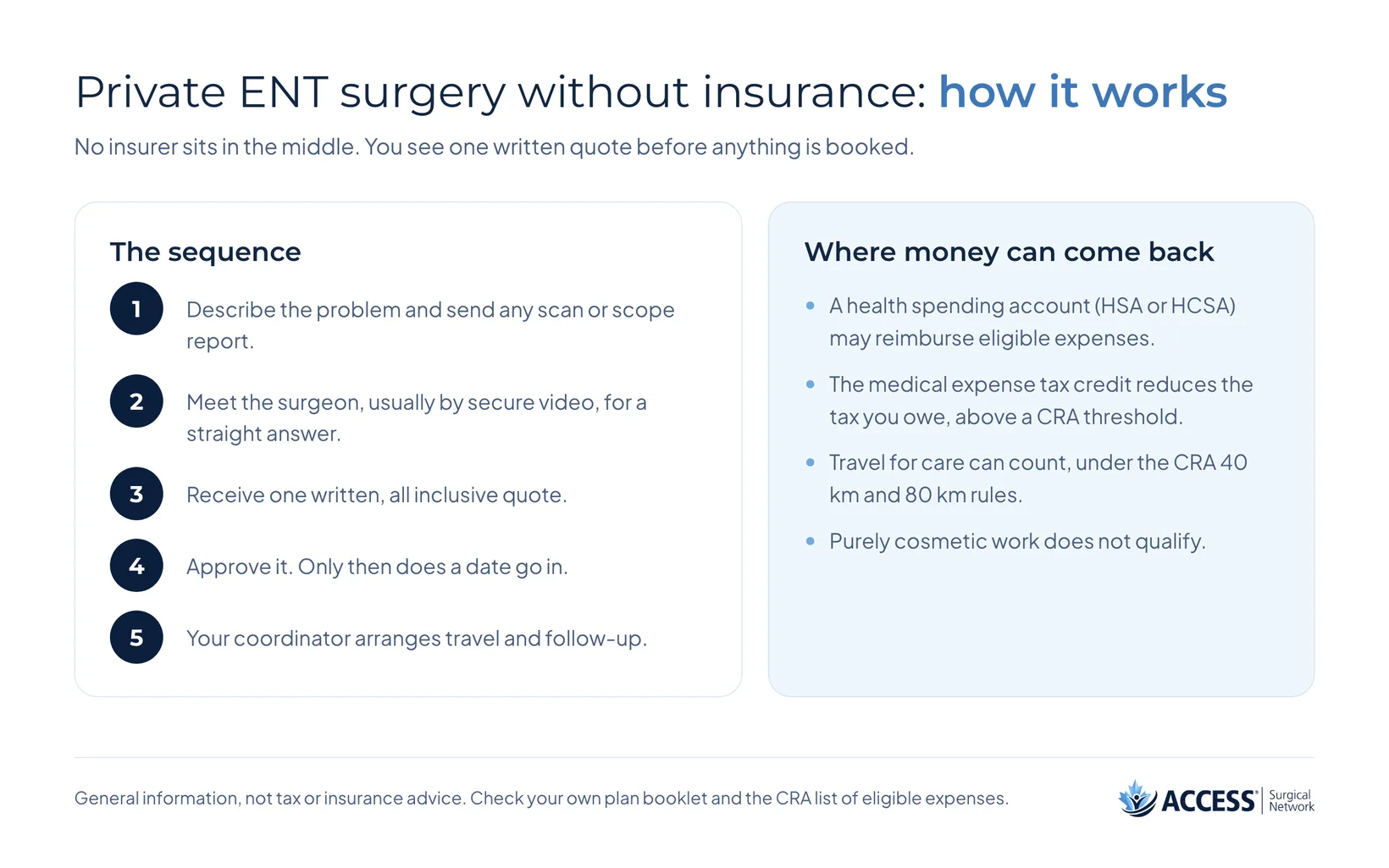
First you describe the problem and send any scan or scope report you already have. Then you meet the surgeon, usually by secure video, and you get a straight answer about whether surgery would help. Some people are told it would not, and that is a real outcome rather than a formality.
If surgery is the right move, you receive one written quote. You approve it, and only then does a date go in the calendar. After that your coordinator arranges the travel and the follow-up. At no point does a third party decide whether you are eligible, because the decision is clinical and it is yours.
The medical expense tax credit when you are paying out of pocket for ENT surgery
This is the one place where money genuinely comes back, so it deserves three plain paragraphs. The medical expense tax credit is non-refundable. It reduces the tax you owe, and it does not arrive as a cheque.
You claim eligible expenses for any 12 month period ending in the tax year, as long as you did not already claim them the year before. Then you subtract a threshold: the lesser of 3% of your net income, or a fixed amount the CRA sets each year. What remains is what the credit works on. And you may claim only the part that nobody paid back to you.
Travel can count too, when you had to go a distance for care that was not available closer to home. The CRA sets its distance rules at 40 km, then again at 80 km, with more to claim at the longer distance. Purely cosmetic procedures, however, do not qualify at all. So read the CRA list of eligible medical expenses and the fuller RC4065 guide, then ask an accountant about your own return. Keep every receipt.
Financing private ENT surgery when you have no insurance
Some patients pay from savings. Others spread the cost over time. So it is worth asking what is available, rather than assuming you have to find the whole sum at once.
ACCESS does not lend money, and it does not sell a financial product. But medical financing exists in Canada, and a line of credit through your own bank is often the plainest route. Ask your coordinator what applies when you book, then compare it against what your bank already offers you.
One honest caution before you sign anything. Interest adds to what you pay overall, and it is easy to leave out of the sum. So treat the financing decision as separate from the surgical one, and take your time over it.
What an all inclusive ENT surgery quote covers
If no insurer is checking the bill, then the bill itself has to be trustworthy. So ACCESS reviews your history and any imaging first, and issues one written quote before you commit to a date.
That quote covers the surgeon, the anesthesia, the facility and our coordination. You see the figure before you agree, and you approve it yourself. There is no later call adding a fee you did not expect.
Ask what sits outside it as well, because travel and accommodation are their own line of thinking. Your coordinator arranges the flights, the hotel and the car around the surgery date, so ask early how that works for your province. The how it works page sets out the sequence from first message to follow-up.
Five questions to ask your benefits provider before you book
Call the number on your card, and write down the date, the name and the answer. Then you have something to point at later.
- Does my plan reimburse surgeon or facility fees at a private clinic in Canada?
- Do I have a health spending account, and what can I put through it?
- Does my plan treat nasal surgery differently when the reason is breathing rather than appearance?
- What paperwork do you need from me: an invoice, an operative report, a letter from the surgeon?
- Is there a deadline for sending a claim after the date of surgery?
If the person on the phone is unsure, ask for the answer in writing. Also ask your employer's HR contact, because they often know the plan better than the call centre does.
Private ENT surgery without full health insurance: common questions
Do I need insurance to book private ENT surgery in Canada?
No. You need a way to pay, and you need a clear quote in front of you before you agree to anything. So the practical first step is a consultation, not a call to an insurer.
Can I use my workplace benefits or a health spending account?
Possibly, and only your plan wording settles it. Plans vary widely, so ask the five questions above before you book rather than after.
Can I claim the cost back from my provincial health plan?
Plan on no. Public plans pay providers inside the public system, so a private invoice is not something they normally settle. But if your circumstances are unusual, ask your provincial ministry in writing.
Is a septoplasty cosmetic for tax purposes?
A septoplasty helps you breathe, and it does not change how your nose looks. However, the CRA weighs eligibility on the facts of each case. So keep the surgeon's documentation, then ask an accountant.
What if I have no extended coverage at all?
Then you are in the same position as most private surgery patients in Canada. You pay directly, you keep the receipts, and you claim what the tax rules allow. Nothing about the pathway changes.
Can I see a written quote before I commit to anything?
Yes. ACCESS gives you one written quote after reviewing your history and imaging, and nothing goes in the calendar until you approve it.
Where to start
Private ENT surgery without full health insurance is the ordinary route here, not the exception. So if you have spent years breathing through one nostril, the insurance question is probably not your real obstacle. The wait is, and you can check how long the ENT wait runs in your province.
Talk to a care coordinator, or read the private septoplasty page first. If it is your sinuses rather than your septum, read how a balloon compares with endoscopic sinus surgery. Either way you get a written quote before you commit to a date, and an honest answer if the operation is not the right move for you.