
If you are weighing balloon sinuplasty vs endoscopic sinus surgery (FESS), here is the part nobody tells you plainly. The choice is not really a preference. One operation widens a blocked sinus opening. The other opens the sinus and clears out what is sitting inside it. So the document that decides is your CT scan, and not the name you like the sound of. Both operations are part of the private ENT surgery we coordinate, and this guide walks through how the choice gets made.
Balloon sinuplasty vs endoscopic sinus surgery: the short answer
A balloon widens a natural drainage opening and takes nothing away. Endoscopic sinus surgery opens the sinus and removes inflamed tissue and polyps.
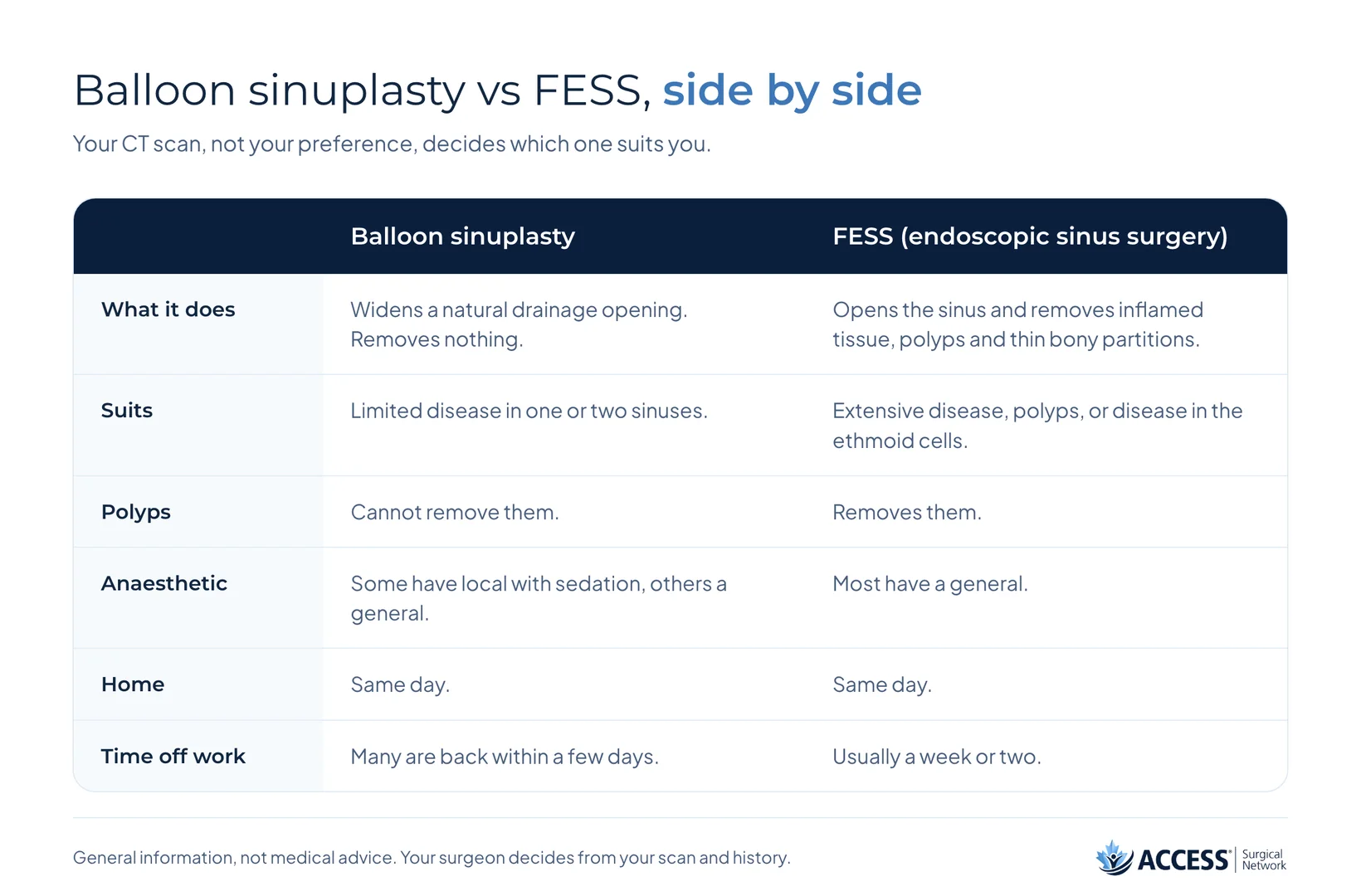
So limited disease in one or two sinuses often suits a balloon. But extensive disease, polyps, or disease in the honeycomb of small cells behind the bridge of your nose does not. Those sinuses need instruments.
If you want the full picture of both operations first, read what a private sinus surgery in Canada involves. This page is about the choice between them.
What balloon sinuplasty does, compared with FESS
A surgeon passes a thin catheter through your nostril and into the blocked opening of a sinus. At the tip sits a small balloon. They inflate it for a few seconds, and it widens the opening. Then they deflate it and take it out.
Nothing comes away. The balloon pushes the walls of the opening apart and leaves the lining in place. Some surgeons flush the sinus with saline at the same time.
Because it stays that simple, the procedure runs short. Some patients have it under local anaesthetic with sedation. Others still prefer a general. Either way you go home the same day.
What FESS does that balloon sinuplasty cannot
Here the surgeon passes a narrow camera through your nostril and works under direct vision. Fine instruments go alongside it. They open the blocked sinuses properly and take out inflamed tissue, polyps and the thin bony partitions that hold disease in.
Surgeons shorten the name to FESS, for functional endoscopic sinus surgery. The word functional matters. The aim is not to strip the sinuses out. Instead the surgeon restores the natural drainage pathways so that mucus moves and your sprays and rinses finally reach the lining.
Most people have this under a general anaesthetic. It takes longer than a balloon, and it still goes home the same day in a private day surgery setting.
Balloon sinuplasty limitations: what a balloon cannot do
This is the section a clinic that only offers balloons will not write, so here it is.
A balloon cannot remove anything. It dilates. So it does not take out polyps, it does not remove thickened lining, and it does not clear fungal debris.
It also cannot open the ethmoid sinuses properly. Those are not one chamber with one door. Rather they are a run of small air cells behind the bridge of the nose, and opening them means taking down the walls between them.
Finally a balloon does nothing about a bent septum. If a crooked septum is part of why you cannot breathe, that needs a septoplasty instead, or as well.
The research bears the pattern out. A systematic review in Otolaryngology Head and Neck Surgery in 2016 found that studies of balloon dilation generally enrolled patients with limited disease on their scans. So that is the group the evidence actually speaks for.
Balloon sinuplasty for nasal polyps: why it is the wrong tool
Polyps are tissue. A balloon removes no tissue. So after a dilation the polyps are still there, and they will still block the airway and dull your sense of smell.
Polyp disease also tends to sit in the ethmoid cells, which is exactly where a balloon cannot reach. So when a scan shows polyps, endoscopic surgery is usually the operation on the table.
If a clinic offers you a balloon and your scan shows polyps, ask why. That single question is worth the appointment.
What FESS asks of you that a balloon does not
The honest other side of the comparison. FESS asks more of you.
You will almost certainly need a general anaesthetic. The operation runs longer. There is more bleeding during it, and more oozing for a day or two afterwards.
Then there is crusting. As the lining heals it forms crusts, and those crusts need clearing. So most surgeons bring you back for one or two clean up visits in the weeks after surgery. It is not painful in the way people fear, but it is not nothing either.
Most people take a week or two away from work. After a balloon, many are back within a few days.
FESS vs balloon sinuplasty recovery, side by side
After a balloon, expect a blocked, bloody nose for a day or two. Then it settles. Most people return to desk work inside a week, and often sooner.
After endoscopic surgery, expect the same blocked feeling but for longer. Your nose will feel worse before it feels better, because swelling inside closes the airway you just had opened. That is normal and it passes.
Both operations end with the same homework. You rinse, and you keep using the spray your surgeon prescribes. Neither operation removes the need for that.
The real difference in recovery, balloon sinuplasty vs FESS, is the clean up visit. If you have travelled for surgery, that visit needs planning before you fly home. Our coordinators arrange it, and the coordination process covers how.
Is balloon sinuplasty as good as FESS? What the evidence says
On balloon sinuplasty vs FESS outcomes we have to be careful, because the honest answer is less tidy than either camp wants.
A systematic review and meta analysis in the Annals of Otology, Rhinology and Laryngology in 2023 pooled the trials comparing balloon dilation with endoscopic sinus surgery. The authors found few high quality studies. In the pooled analysis the gap in symptom score improvement between the two fell below the level they treated as clinically meaningful.
So among the patients who were suitable for either, neither operation pulled clearly ahead on symptoms. But the same authors concluded that better studies are still needed, and they named that gap themselves.
Read that carefully. It is not evidence that a balloon handles polyp disease. Those patients were never in the trials.
Durability: balloon sinuplasty vs FESS over time
People want to know which lasts longer, balloon sinuplasty vs FESS. The truthful answer is that good comparative data on revision rates remains thin, and we will not invent a number to fill the gap.
What we can say is the mechanism. Surgery changes plumbing. It does not change the tendency of your lining to inflame. So if the underlying disease stays active and you stop your treatment, symptoms can return after either operation.
Revision surgery does happen, and it happens after both. When it follows a balloon, it is often because the disease was more extensive than the first plan allowed for.
Hybrid procedures: a balloon on some sinuses, instruments on others
The comparison is not always either or. A surgeon can dilate a frontal sinus with a balloon and still use instruments on the ethmoid cells in the same sitting.
That approach makes sense when your scan shows one badly affected area and one mild one. So you get the thorough operation where you need it, and the gentler one where you do not.
The 2023 review named hybrid procedures as one of the things future trials should study. So nobody should oversell it. But it is a real option, and it is worth asking about.
Which sinus surgery do I need? Five questions to ask your surgeon
You cannot read your own scan. But you can tell whether the recommendation came from the scan or from habit. So ask these.
- Which of my sinuses are actually affected, and can you show me on the images?
- Do I have polyps, and where?
- Do you perform both operations, or only one of them?
- If we start with a balloon and it is not enough, what happens next?
- Is my septum or are my turbinates part of the problem too?
Question three matters most. A surgeon who performs only one operation can only recommend one operation. That is not dishonesty, but it does narrow the advice you get.
Why your CT scan decides, and not your preference
A sinus CT shows which sinuses have filled, how thick the lining has become, and whether the small drainage channels have closed. It also shows the shape of your anatomy, which tells the surgeon what is safe.
So the scan sorts patients into rough groups. Limited disease in the maxillary or frontal sinuses with a clear ethmoid tends to point toward a balloon. Widespread opacification, polyps or heavy ethmoid disease points the other way.
Because our ENT surgeon performs both operations, the recommendation follows your scan rather than the equipment in the room.
What neither operation fixes
Both operations open drainage pathways. Neither one cures the tendency of your lining to inflame, so the rinses and the spray continue afterwards.
Neither reliably fixes facial pain that is not coming from your sinuses in the first place. And neither treats allergy, which drives a great deal of nasal misery on its own.
Smell is the honest one. Many people notice it improve, especially when polyps come out. But no surgeon can promise it, and anyone who does is overselling.
If you have not yet had a proper trial of medical treatment, that comes first. The MedlinePlus overview of sinusitis from the United States National Library of Medicine is a plain starting point.
Where waiting fits into the decision
There is a quiet problem behind all of this. Canada reports wait times for a short list of priority procedures, and sinus surgery is not on it. The CIHI priority procedures reporting covers hip and knee replacement, hip fracture repair, cataract surgery and cancer care.
So the sinus wait is real, and nobody publishes a national benchmark for it. We have gathered the ENT wait figures each province does publish. Those waits are why people start looking privately.
The rule that governs paying privately is about where you live, not where your surgeon works. You cannot privately buy an insured service in the province that insures you. But you may travel to another province and buy it there, which is lawful and ordinary. Most people do it with no insurance involved, and we explain how paying for it yourself works. See the ENT procedures we coordinate for what that covers.
Common questions about balloon sinuplasty vs endoscopic sinus surgery
Can I just ask for the balloon because it sounds easier?
You can ask. But if your scan shows polyps or ethmoid disease, a balloon will not fix it. Then you have had an operation and still have the problem.
Does a balloon hurt less than endoscopic surgery?
Most people describe pressure rather than pain during a balloon procedure. Recovery is generally shorter and lighter too. Even so, both are real operations.
Will my nose be packed afterwards?
Packing is far less common than it used to be. Many surgeons use dissolvable material instead, or nothing at all. Ask your own surgeon, because practice varies.
Can I have a balloon after a previous sinus operation?
Sometimes, and it depends on what the first operation did and what your current scan shows. So this is a question for a surgeon with your images in front of them.
Do I need a septoplasty as well?
Often the two go together, because a bent septum can block access to the sinuses. Your surgeon will tell you after the examination and the scan.
How long before I know whether it worked?
Give it time. Swelling settles over weeks, and the lining keeps improving for months. So most surgeons review you at intervals rather than once.
Where to go from here
If your scan is done and you are choosing between the two, bring the images to a surgeon who performs both. That is the single most useful thing you can do.
If you have not reached that point, start with the full guide to sinus surgery and how the two operations differ. Then talk to a coordinator when you are ready, and we will tell you honestly if surgery is not your answer yet.