
ENT wait times in Canada are hard to pin down, and there is a reason for that. No national body counts them. So most of the figures you find online carry no source behind them at all. This page sets out the best estimate for every province, what each government actually publishes, and what patients tell us directly. It also explains the two separate waits, what the published figures quietly leave out, and what changes if you choose private ENT surgery instead.
ENT wait times in Canada: the short answer
There is no official national number. Canada benchmarks a short list of operations, and no ENT procedure sits on that list. The best estimate comes from a yearly survey of specialists by the Fraser Institute. In its 2025 report, the median wait for ENT care from a family doctor's referral to treatment was 43.8 weeks. That is roughly ten months.
The spread between provinces is wide. Newfoundland and Labrador sat at 20.5 weeks and Ontario at 33.1 weeks. New Brunswick sat at 127.7 weeks, which is close to two and a half years. The full table by province is below.
Nova Scotia gives the clearest picture, because it reports ENT waits by procedure and by clock. Take the period from 1 May to 31 July 2026. Half of its septoplasty patients waited 113 days or less to see a surgeon. Then half waited a further 131 days or less for the operation itself. Add the two together and a patient in the middle of both queues faces roughly eight months.
Other ENT operations there run shorter. Sinus surgery sat at 91 days and then 106 days. Adult tonsillectomy sat at 66 days and then 105 days. Nova Scotia is also the only province that names individual ENT operations in its own reporting, so it gets its own section further down.
Why no national ENT wait time exists
The Canadian Institute for Health Information reports on wait times for priority procedures. That list covers hip and knee replacement, hip fracture repair and cataract surgery. It also covers several cancer surgeries, cardiac bypass, radiation therapy and diagnostic imaging. No ear, nose and throat operation appears anywhere on it.
That absence matters more than it first looks. A benchmark is not simply a number. It carries a target, public reporting, and pressure on any province that misses it. ENT surgery carries none of that.
So a missing figure does not mean the wait is short. It means nobody has to answer for it in public. In short, some of the operations Canadians wait longest for are the ones nobody sets a target for.
How long to see an ENT specialist in Canada
Most people asking this question are really asking about two queues. They run one after the other, and each province measures them separately. So a single number rarely describes what you will actually live through.
Wait 1: referral to the ENT consultation
This wait starts when your family doctor sends a referral. It ends when you finally sit down with an ENT surgeon. Nobody books an operation before that appointment happens.
Nova Scotia calls this the surgeon consult wait time. Its own guide to the numbers defines it as the days a patient waits for a first appointment after a referral. British Columbia measures the same stretch and calls it the wait to see a surgeon. Most other provinces publish nothing for it.
Wait 2: the decision to operate, then the operation
The second wait starts when you and the surgeon agree that surgery makes sense. It ends on the day of the operation. British Columbia starts its clock a little later, when the health authority receives the booking form.
Nova Scotia also strips out emergency cases, and any days when a patient could not accept a date. So the published figure measures the system cleanly. It does not measure your life cleanly. As a result, you can wait far longer than the number suggests and still count as typical.
What to ask when a wait time is quoted at you
Numbers get thrown around a lot in this field. Five questions will tell you whether one is worth trusting.
- Which clock does the number measure?
- Does it cover the wait to see the surgeon, or only the wait for the operation?
- What dates does the data cover?
- Is it a median, or is it an average?
- Where can I read the source myself?
If the answer to the last one is no source, treat the number as a guess. Most of the ENT waits quoted online fail that test.
ENT wait times in Canada by province
Only two provinces publish ENT waits of their own. So the only source that covers every province is the Fraser Institute's yearly survey, Waiting Your Turn 2025. It asks specialists how long their patients wait, and reports the median for each province.
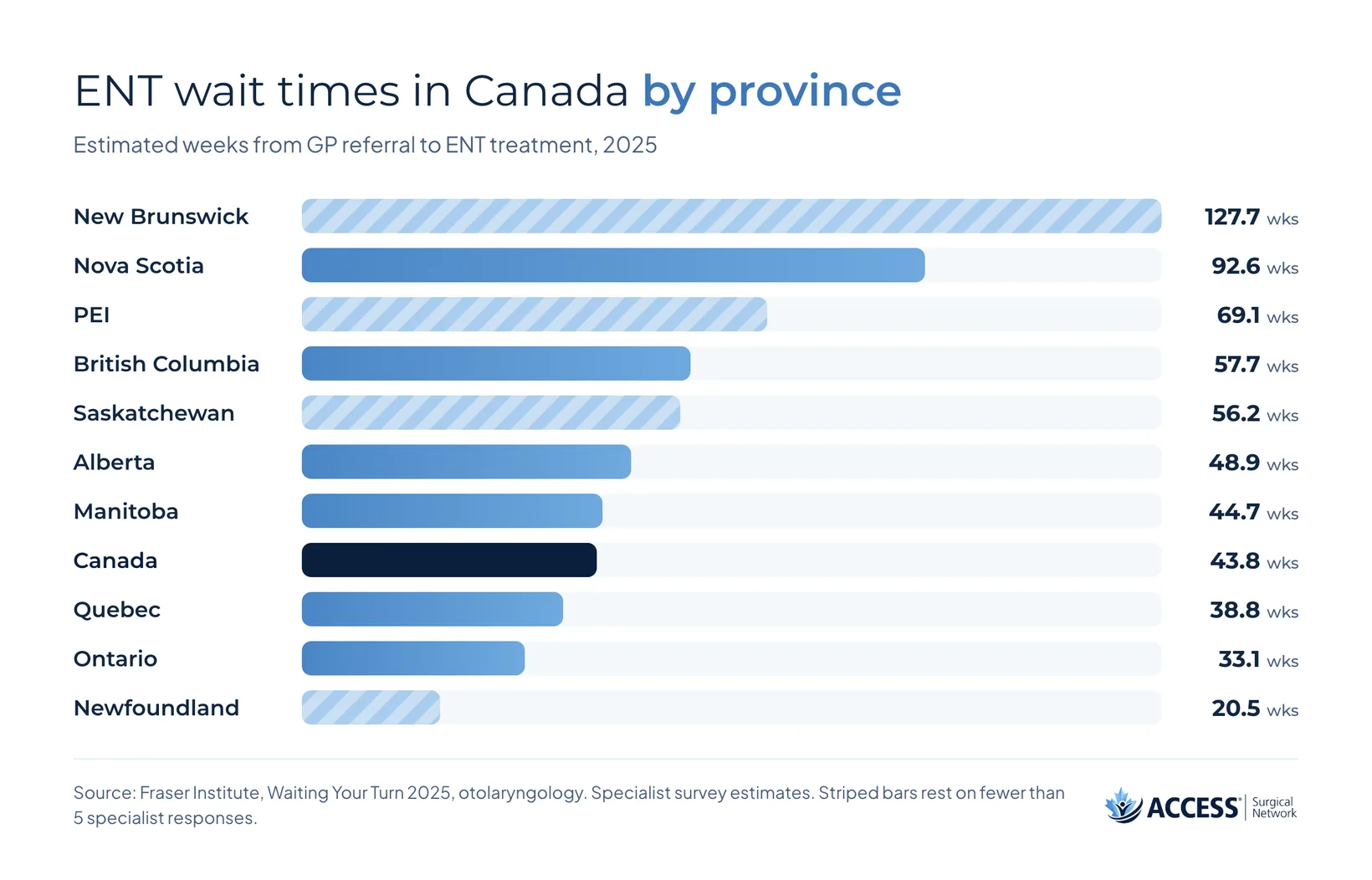
Estimated ENT wait by province, 2025
| Province | Referral to ENT consult | Consult to treatment | Total, referral to treatment |
|---|---|---|---|
| British Columbia | 34.0 weeks | 23.7 weeks | 57.7 weeks |
| Alberta | 23.0 weeks | 25.9 weeks | 48.9 weeks |
| Saskatchewan* | 32.0 weeks | 24.2 weeks | 56.2 weeks |
| Manitoba | 28.0 weeks | 16.7 weeks | 44.7 weeks |
| Ontario | 20.0 weeks | 13.1 weeks | 33.1 weeks |
| Quebec | 12.0 weeks | 26.8 weeks | 38.8 weeks |
| New Brunswick* | 77.5 weeks | 50.2 weeks | 127.7 weeks |
| Nova Scotia | 60.0 weeks | 32.6 weeks | 92.6 weeks |
| Prince Edward Island* | 58.0 weeks | 11.1 weeks | 69.1 weeks |
| Newfoundland and Labrador* | 6.0 weeks | 14.5 weeks | 20.5 weeks |
| Canada | 22.4 weeks | 21.4 weeks | 43.8 weeks |
Source: Fraser Institute, Waiting Your Turn 2025, tables 2, 3 and 4. The survey ran from January to May 2025. Fraser reports the total separately, so it does not always equal the two waits added together.
*Read the starred rows with care. Fewer than five ENT specialists answered the survey in each of those provinces, and in Newfoundland and Labrador only one did. A single reply can swing the figure a long way. Ontario, with 46 replies, is the most solid number in the table.
Quebec sits at 38.8 weeks from referral to treatment, close to the national figure. The survey reports provinces, not cities, so that provincial number is the best available estimate for patients in Montreal, Laval and the rest of Quebec.
The survey also estimates how many procedures are waiting. In Ontario alone, it put the number at about 4,000 tonsil and adenoid operations, about 3,000 sinus operations and about 750 septal or nasal operations, all waiting after the patient had already seen the surgeon.
ENT wait times in Ontario: what patients tell us
Ontario publishes no ENT wait of its own, so here is something no table carries: what people tell us when they contact ACCESS. Ontario patients asking about ENT surgery have described waits of six months to a year for some procedures.
These are their own accounts, not measured data, and we do not treat them as statistics. But they line up closely with the Fraser estimate above. Ontario's 33.1 weeks works out to roughly seven and a half months from referral to treatment, and half of patients wait longer than that.
What each province publishes itself
Here is what each province's own government puts in public, checked in September 2026. Where a province publishes no ENT figure, we leave the space empty rather than fill it with a guess. An honest gap is more useful than a confident invention.
Provinces that publish an ENT or otolaryngology wait
| Province | What it publishes for ENT | Which clock | Source |
|---|---|---|---|
| Nova Scotia | ENT by specialty, by surgeon and by named procedure | Consult and surgery, both | Nova Scotia wait times |
| British Columbia | Scheduled surgery by individual procedure, searchable A to Z | Both clocks defined | BC surgical wait times |
Nova Scotia refreshes its busiest services monthly and the rest quarterly. British Columbia updates every two months, and each figure covers scheduled surgeries completed in the most recent three month window.
Provinces that publish no ENT figure
| Province | What it publishes instead | Source |
|---|---|---|
| Manitoba | Cardiac, cataract, hip and knee only | Manitoba surgical services |
| Newfoundland and Labrador | Cataract, hip, knee, cancer surgery and cardiac bypass | NL wait times |
| Saskatchewan | All surgery combined, as a share treated within three, six and twelve months | Saskatchewan surgical performance |
Saskatchewan reports volume rather than specialty. Between 1 April and 30 June 2026 it performed 27,342 surgeries, and 75.2 per cent of patients received surgery or an offer of surgery within three months. That tells you something useful about the system. It tells you nothing about ENT.
What we could not confirm
Ontario, Quebec, Alberta, New Brunswick, Prince Edward Island and the three territories sit in neither table. We could not verify a government ENT figure for any of them, so for those provinces the Fraser estimate above is the best available number.
Ontario is the gap that matters most, because it is the largest province. Its public reporting follows the national priority procedures, and ENT falls outside them. If you hold a current Ontario government ENT figure with a live source behind it, we would like to see it.
Ear nose and throat surgery waiting list figures, procedure by procedure
Nova Scotia is the only province we found that names individual ENT operations in public. So every figure below comes from there. They cover 1 May to 31 July 2026 and appeared in September 2026. Treat them as one honest window, not a national average.
Septoplasty
Half of patients waited 113 days or less to see the surgeon. Then half waited 131 days or less from decision to operation. That is the longest combined ENT wait in the province's own reporting.
A septoplasty straightens the wall between the nostrils. Our septoplasty page explains what the operation involves, and MedlinePlus describes it in plain clinical terms.
Sinus surgery
Sinus surgery sat at 91 days to consult and 106 days to operation. Nova Scotia reports functional endoscopic sinus surgery separately, and that sat at 49 days and then 111 days. So the consult wait shifts sharply depending on which label the referral carries.
That gap is worth noticing before you compare two numbers from two provinces. Our sinus surgery page sets out what the operation treats and when it helps. If a balloon procedure has been mentioned to you, our guide to balloon sinuplasty and endoscopic sinus surgery explains how the two compare.
Tonsillectomy
Adult tonsillectomy or adenoidectomy sat at 66 days to consult and 105 days to operation. Nova Scotia counts adults as sixteen and over, and reports children separately. Our tonsillectomy page covers the adult operation.
How the three ENT operations compare
Put the three side by side and a pattern shows up. The surgery waits cluster close together, from 105 to 131 days. The consult waits spread much wider, from 49 to 113 days.
So in Nova Scotia the queue to get in the door varies more than the queue to reach the table. That runs against what most people assume. They picture a long wait for theatre time and a quick chat with a specialist first.
It also means the part of the journey that nobody else publishes is the part that moves most. Two provinces could report the same surgery wait and still send patients down very different roads.
Why the wait for ENT surgery runs so long
Three things drive ENT wait times in Canada, and none of them are secret.
First, hospitals sort their lists by urgency. Cancer, heart and trauma cases go first, and they should. A blocked nose is not an emergency, so it sits near the back of the queue. That is triage working as designed.
Second, the limit is operating room time, not the number of surgeons. Each room runs a set number of hours a day. So an ENT list moves at the speed of the room rather than the speed of the need.
Third, there is no target to miss. A province with a long hip list gets asked about it in public every year. A province with a long ENT list does not. That is the structural reason ENT wait times in Canada run long and stay unmeasured.
What the ENT referral wait by province does not capture
Three groups are missing from every figure on this page, and none of them are small.
First, the clock only starts at referral. So anyone whose family doctor never sends one never enters the count at all. If you have been told to try another spray and come back in six months, you are invisible to this data.
Second, Nova Scotia states plainly that its wait time covers only patients who did need surgery. People who saw a surgeon and went home without an operation drop out. That is medically correct, and it also shortens the reported number.
Third, people give up. Nobody counts the patient who stopped chasing the referral after the second year. In short, the published figures describe the people who made it through, not the people who did not.
How we compiled this, and where it falls short
Every figure here comes from a source we opened ourselves: the provincial portals, and the Fraser Institute report itself. Every figure carries its source link. We took no number from a secondary summary or a news article. The patient accounts are labelled as exactly that.
Four limits matter. The Fraser figures are specialists' estimates from a survey, not records from a booking system, so they measure something different from the government portals. That is why Nova Scotia's survey figure runs longer than its own portal. The provinces also run different clocks, so a Nova Scotia number and a British Columbia number are not directly comparable. The reporting periods differ too, and each province refreshes on its own schedule. And these are percentiles rather than averages, so a median of 113 days means half of patients waited longer.
Read any single figure on ENT wait times in Canada as a signal, then. It is not a promise about your own case, and no honest page can make one.
How to wait well while you are in the queue
Waiting is not the same as doing nothing. A few small things are worth your time.
Keep a short record of your symptoms and how they affect sleep, work and exercise. Take it to every appointment. It turns a vague story into something a surgeon can act on.
Ask the clinic whether it keeps a cancellation list, and ask how to get on it. Then say yes if a short notice date comes up.
Check that the referral actually went out. Referrals do go astray, and a phone call costs you nothing.
Go back to your doctor if things change. Nova Scotia puts this on its own site: if your symptoms change while you wait, get reassessed.
And stay open to the answer that surgery is not the answer. Some blocked noses improve with treatment that involves no operation at all. A good surgeon will tell you so, and that is a result worth having.
What changes if you go private
A private pathway takes you out of the ENT wait times in Canada described above, but it does not remove the medicine. You still need a proper assessment, and a good surgeon will tell you when an operation is not the answer. Many blocked noses respond to treatment that involves no surgery at all.
ACCESS coordinates care rather than selling operations. We arrange the consultation, the imaging, the date, the travel and the follow up, and the surgeon and the facility remain the clinical decision makers. Our how it works page sets out the sequence, and the ENT procedures hub covers what we coordinate.
If you would be paying for it yourself, we explain how paying without insurance works, including the medical expense tax credit. If you want a straight answer about your own situation, talk to a coordinator.
ENT wait times in Canada: common questions
How long is the wait to see an ENT specialist in Canada?
It depends on where you live. The Fraser Institute's 2025 survey put the national median at 22.4 weeks from referral to the ENT consultation. It ranged from 6 weeks in Newfoundland and Labrador to 77.5 weeks in New Brunswick, though both of those rest on very few replies. In Ontario it was 20 weeks.
Which province publishes the most ENT wait time data?
Nova Scotia, by a clear margin. It reports otolaryngology by specialty, by surgeon and by named procedure, and it publishes both the consult wait and the surgery wait. British Columbia publishes by procedure too, though its ENT coverage is harder to confirm from the outside.
Why is ENT surgery missing from the national priority list?
Canada chose a short benchmark list years ago, and it centred on joint replacement, cataracts, cardiac care and cancer. ENT never made it on. So the national reporting tool has no ENT figure to show you, and no province faces a published ENT target.
Can I be referred to an ENT surgeon in another province?
Yes. Canadians travel between provinces for surgery every year, and the rule that governs privately paid care turns on the patient's home province rather than the surgeon's. So a pathway that is closed at home can be open one province over. A coordinator can explain how that applies to you.
Last reviewed, and permission to cite
We last reviewed this page on 22 October 2026, and we check every source link and figure at least twice a year. The Fraser figures will be updated when the next edition of the report is published. When a province starts publishing an ENT wait, we will add the row and say when it arrived.
Journalists, researchers and clinicians are welcome to cite this page or reuse the provincial table, with a link back. If you spot an error or a source we missed, tell us and we will correct it.